
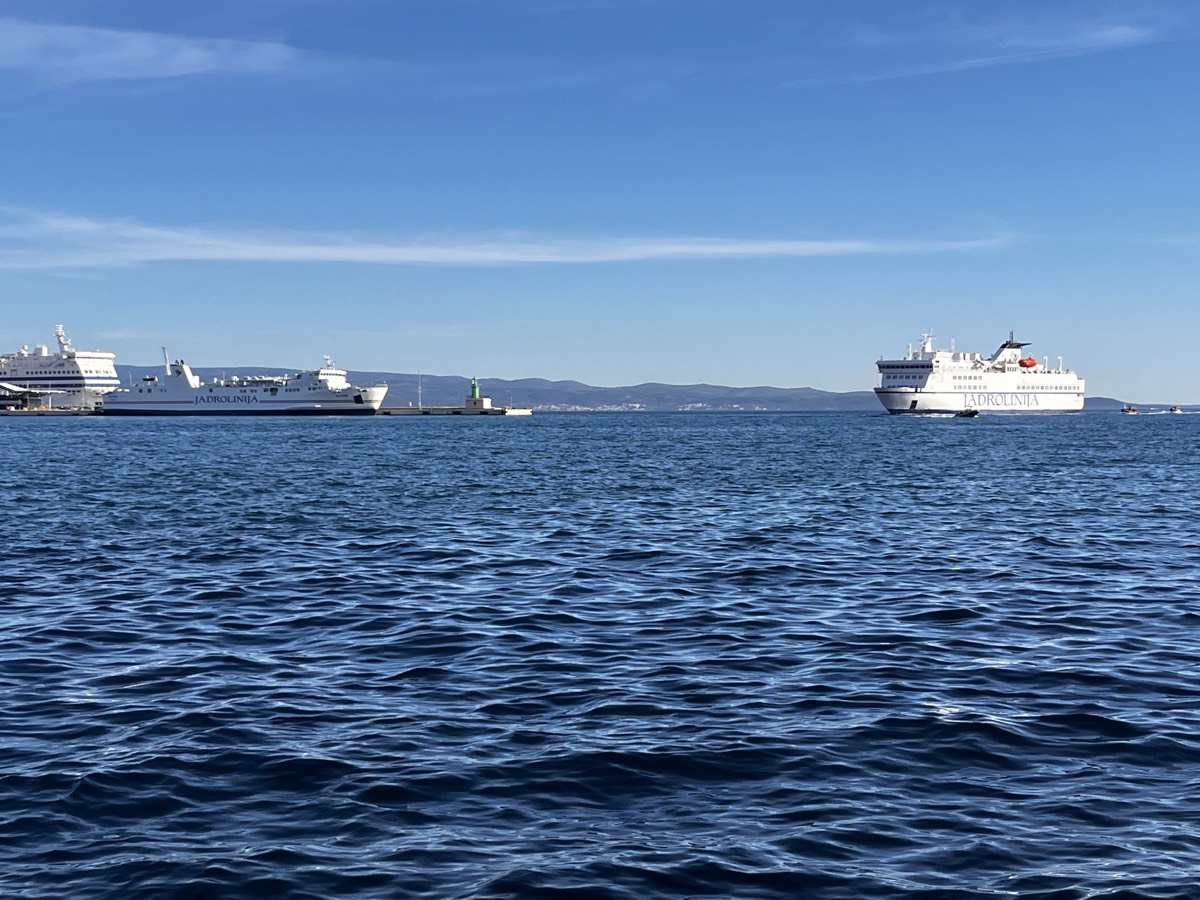
The short answer (read this first)
Yes, you will make it back. Every shore excursion we run from Split cruise port is timed to drop you at the terminal at least 60 minutes before your ship's all-aboard. In practice the buffer is usually larger. We build that buffer in deliberately so the normal stuff — bridge openings at Trogir, an extra 10 minutes at the Krka boardwalks — does not eat into your safety window.
- Minimum buffer at the cruise terminal: 60 minutes before all-aboard.
- We confirm your ship's exact arrival and all-aboard the day before, and adjust pickup if anything has shifted.
- If the day goes sideways for reasons we control (a vehicle issue, a late guide), getting you back is on us — including organising onward transport to the next port if it ever came to that.
- If the day goes sideways for reasons nobody controls (road accident, park flooding), the buffer absorbs most of it; missed-departure travel insurance is the standard cushion for the rest.
How "all-aboard" actually works at Split port
Two times matter on a cruise day, and they are not the same thing.
Departure time is when the ship physically leaves the berth. It is printed in your daily programme and on the gangway sign as you step off the ship. All-aboard time is 30 minutes earlier — the time by which every passenger must be back through ship security. Crew walk the dock from about 15 minutes before all-aboard, and the gangway is pulled the moment all-aboard passes. There is no informal grace period; if you are not on board, the ship leaves and your passport is left with the Split port agent.
Both times are written on the gangway-side sign every time you disembark, in big numbers, in 24-hour format. Take a photo of that sign on the way out — it is the most reliable record of the day's all-aboard.
How long a port call do I need for each tour?
Most ships give you between 8 and 10 hours in Split. Some lines run shorter (7-hour calls do happen), some run a long port-of-call day at 11+ hours. Here is the headline math for a typical 9-hour port call with all-aboard half an hour before departure:
| Tour | Tour length | Minimum port call | Typical buffer |
|---|---|---|---|
| Split & Trogir small-group | 5 hours | 7 hours | 90+ min |
| Split & Trogir private | 5 hours | 7 hours | 90+ min |
| Primošten private | 5.5 hours | 8 hours | 75+ min |
| Krka & Trogir private | 6 hours | 8.5 hours | 60+ min |
The buffer figures are total day-end cushion — the time between scheduled tour return and ship all-aboard. They assume a normal pickup within 30 minutes of disembarkation; on a tender day or for a delayed gangway opening, that pickup window shifts and the cushion drops accordingly.
The "minimum port call" column is the rule we apply when accepting bookings. We will not run the 6-hour Krka tour for a 7-hour port call — it leaves no room to absorb any delay, and the result is a tour where the guide is checking the clock instead of showing you the cascades. If your port call is shorter than the minimum for a tour you want, the right answer is a different tour, not a tighter run.
What can actually delay you (and what we control vs don't)
Things we control: the vehicle, the guide, the route, when we leave each stop. We run modern diesel vans serviced before the season and we keep a backup vehicle in Split. If our van failed at Krka, you would be in another van within 40 minutes — that is the operating standard, not a wish.
Things we partly control: route choice. The Trogir bridge opens periodically for tall boat traffic and can hold up the coastal route by 10–15 minutes. If we see it about to open, we route inland through Kaštela. The Solin junction outside Split bunches up in late afternoon during peak summer; we leave Trogir 15 minutes earlier on August Wednesdays to skip it.
Things nobody controls: a road accident on the A1 motorway, a sudden Krka park closure due to flooding, a tender-process slowdown if your ship is on tender that day. The buffer is sized for these — a 60-minute return window absorbs almost all real delays.
Independent vs ship's excursion: the missed-ship myth
Cruise lines tell you the same thing in every welcome briefing: "Only ship-sponsored excursions guarantee the ship will wait for you." That is technically true. It is also slightly misleading, and it is worth understanding the actual mechanics.
On a ship-sponsored excursion, if the bus is late, the ship is contractually obligated to either wait or fly you to the next port at the cruise line's expense. On an independent excursion, that contractual link does not exist — but it does not mean you are abandoned. We monitor your ship's schedule, we know the all-aboard time, we run the tour around it, and if a real delay puts you behind, the protocol kicks in: guide calls the Split port agent, operator funds onward transport to the next port. The legal mechanism differs from a ship-sponsored tour; the customer outcome — getting to your ship — does not.
Where the cruise-line warning carries weight: on operators with no local presence and no shared phone with the guide, on tours sold cheap by a kiosk on the Riva with no booking record, and on day-of arrangements made through a hotel concierge for a guide they have never used. That is genuinely riskier. "Operator we can call by name on a Split number" is the line that matters, not "booked on the ship versus off the ship."
What we do on our end to protect your timing
- Pre-tour port-call check. We pull your ship's confirmed Split schedule the day before — berth or tender, arrival, all-aboard. If something has changed, we email you that evening with the adjusted pickup time.
- Route selection on the day. The guide picks the route based on what the road is actually doing that morning, not the route we put on the website.
- One phone, one decision-maker. Your guide has the route call. There is no "let me check with the office" — if the bridge is opening they pivot inland on their own authority.
- Drop at gangway, not "near port." Every tour ends at the cruise terminal vehicle drop-off. You walk no more than two minutes to your ship's gangway. Some operators end the tour at a parking lot 1 km away to save time; we do not.
- Return earlier than scheduled if anything is iffy. If the morning is slow at Krka or there is a forecast we do not love, the guide returns 15 minutes ahead of schedule rather than running it close.
Red flags when booking any Split shore excursion
Worth knowing even if you do not book with us:
- No buffer number. If an operator says "we'll get you back in time" without naming a specific minimum return time before all-aboard, they have not actually thought about the buffer.
- Tour ends "around" all-aboard. The end time should be at least 60 minutes before all-aboard, full stop. "Returns by departure time" is not a buffer.
- No local phone number. A Croatia-based mobile number you can reach the guide on. Not a booking-platform email-only contact.
- No Bokun, Viator, GetYourGuide, or Tripadvisor booking record. A cash-only deal arranged by a kiosk on the Riva is exactly the situation cruise lines warn about, and they are right about that one.
- Vague pickup point. "Meet at the cruise terminal entrance" without a specific door, sign, or name is the start of a stressful morning.
Picking the right tour for your port-call length
Match the tour to the time you have, not the other way around:
- 7-hour port call (or tender day): book the 5-hour Split & Trogir small-group tour or its private equivalent. Both leave a comfortable buffer even on shorter calls.
- 8-hour port call: any of the three private 5–5.5 hour tours fit cleanly, including Primošten for cruisers who want a beach stop.
- 9-hour port call or more: the 6-hour Krka & Trogir tour is the right pick. The buffer is generous and lets the day breathe at the boardwalks — see our Krka-from-a-Split-cruise breakdown for what those six hours actually look like.
For more on the practical differences between those formats see private vs small-group, and where ships actually dock in Split for the geography of pickup and return.